NS United Kaiun Group , as a global corporate group, has established a Group Corporate Philosophy and a Code of Conduct to realize this philosophy. Recognizing that it is our social responsibility to respect human rights as stated therein, we have formulated the “NS United Kaiun Group Human Rights Policy” ("Policy") as follows.
This Policy was established by the Board of Directors on January 31, 2023, and approved the revision by the Board of Directors on March 27, 2025.
As we have subsidiary in UK, which is assigned a key role in boosting relationships with sustainability-focused customers in Europe, winning new contracts for environmentally conscious business, and collecting information about the situation in Europe as the world leader in promoting environmental action, in response to the "Modern Slavery Act 2015" of the United Kingdom, we have published a "Modern Slavery Statement" on our website as follows.
Through our Group Supplier Guidelines, we require our suppliers to support and respect human rights in line with internationally recognized standards. In particular, we require their cooperation in supporting internationally recognized human rights, prioritizing respect for human life, and honoring the fundamental human rights and individual diversity of each person.
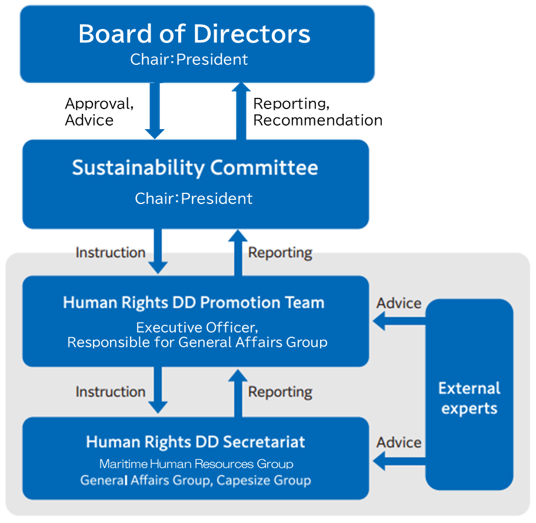
Based on the Human Rights Policy, we are promoting efforts to respect human rights under the following framework. We have designated the ESG/Internal Control Team within the General Affairs Group as the team responsible for coordinating human rights initiatives, and are promoting cross-group initiatives across the Group.
The Promotion Team reports discussion results to the Board of Directors by way of the Sustainable Committee.
*DD:Due Diligence
We host the Sustainability Committee once every six months, which is chaired by the President, Representative Director and Executive Officer and the membership consists of all executive officers. With regards to general sustainability matters, including human rights, the committee discusses how to proceed with such matters, checks the status of initiatives, reports to the Board of Directors, and makes suggestions.
We have established a cross-departmental Human Rights DD Promotion Team (hereinafter, the “Promotion Team”), which is composed of the relevant directors and executives. Approximately once every two other months, the Promotion Team monitors human rights DD and assesses initiatives based on the report from the Human Rights DD Secretariat.
The Human Rights DD Secretariat (hereinafter, the “Secretariat”) composed of the following three departments has been established to conduct discussions.
In cooperation with each department and according to our Human Rights Policy, the Secretariat examines and implements initiatives for respecting human rights, human rights DD, and preventive and corrective measures against human rights risks, and reports the results thereof to the Human Rights DD Promotion Team.
- General Affairs Group: responsible for onshore personnel affairs and promoting ESG management
- Maritime Human Resources Group: responsible for offshore personnel affairs (seafarers)
- Capesize Group: representative of sales divisions
In order to implement initiatives for respecting human rights properly in accordance with the UN Guiding Principles on Business and Human Rights, we regularly receive advice from SDG Partners, Inc., a specialist consultant, to ensure the objectivity and validity of each phase of implementing initiatives.
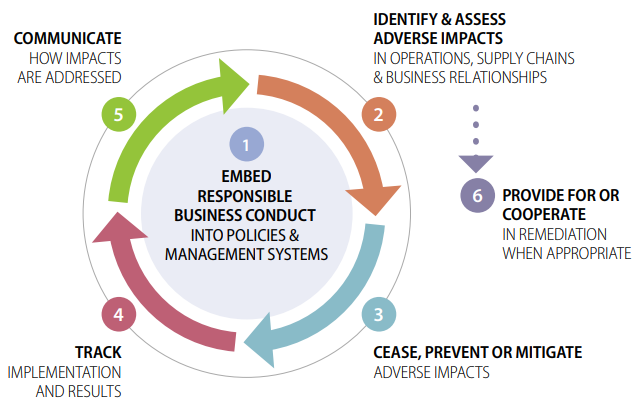
At present, we are working to identify and assess actual and potential adverse impacts on human rights caused by our Group’s business activities. This is to understand the relevant situation accurately and take appropriate steps in order to avoid or mitigate the adverse impacts.
- 拡大
- OECD (2018), OECD Due Diligence Guidance for Responsible Business Conduct
Design:Peggy King Cointepas
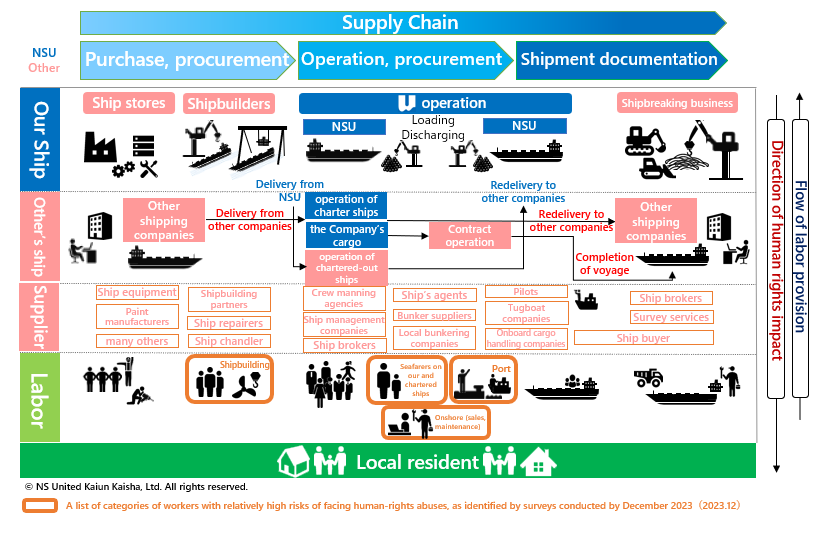
Starting from August 2023, we assess human rights risks in reference to external experts’ advice and international indicators of country-specific human rights risks and the like, specifically by identifying risk factors to be taken into account when conducting the Group’s business, specifying stakeholders that may be affected, and performing desk analyses working with related business divisions.
|
Target Operations |
International Shipping |
|
Target Countries |
WALKFREE - GLOBAL SLAVERY INDEX Africa 5 countries, America 15 countries, Europe 22 countries, Oceania 3 countries, Middle East 3 countries, South Asia 3 countries, East / Southeast Asia 11 countries |
|
Cargo |
Iron ore, Steel products, Coal, Coke |
|
Human Rights Issues |
Occupational Health and Safety, Rights of Foreign Workers, Forced Work, Insufficient / Unpaid Wages / Living Wages, Discrimination, Child Labour, Excessive / Unfair Work, Sexual Harassment, Power Harassment, General Vulnerability, Industry-Specific Vulnerability, Right to Social Security, Discrimination, Freedom of Residential Transfer, Freedom of Association, Human Rights Issues Related to Gender, Rights of Indigenous Peoples and Local Populations, Human Rights Issues Related to Environment and Climate Change |
|
Date |
International Shipping |
|
Participating Department |
|
|
Contents |
|
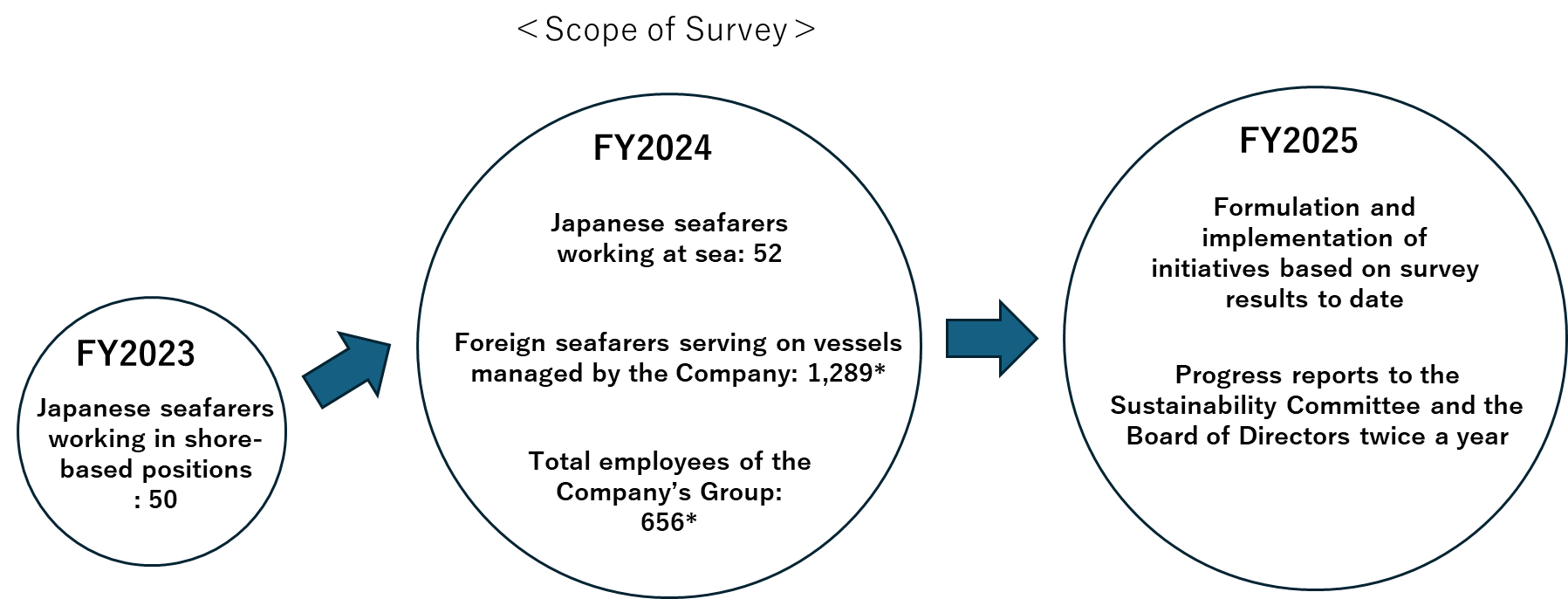
We have been developing mechanisms for human rights assessments and remediation while gradually expanding the scope of coverage.
From fiscal year 2023 to fiscal year 2024, we initially launched initiatives targeting Japanese seafarers, and subsequently expanded the scope of our surveys to include office workers, Group companies, and foreign seafarers, making use of existing survey frameworks and other tools. The results of surveys are compiled into reports and shared with respondents through internal postings and other channels. In addition, the results are reported to the Board of Directors through the relevant committees.
In fiscal year 2025, reflecting the results of these surveys, we formulated an improvement plan and established a framework under which progress is reported to the Board of Directors semiannually via the Sustainability Committee. Looking ahead, we will also consider extending these initiatives to external business partners across our supply chain.
Seafarers are core human resources that support our most important corporate value: safe vessel operations. Maritime service entails vessel-specific burdens, including constraints on living environments. Accordingly, we position the maintenance of seafarers’ health and the assurance of safe working conditions as a fundamental responsibility and are undertaking systematic initiatives based on industry guidelines.
To maintain and enhance physical and mental health, we conduct regular medical checkups and continuously promote initiatives aimed at improving mental health and preventing harassment. Through training programs such as e‑learning for seafarers and age-based, in-person group workshops, we work to improve awareness regarding harassment, enhance workplace environments, and foster healthy interpersonal relationships.
In addition, consultation desks are established in Japan, the Philippines, and Vietnam according to seafarer resources, creating an environment in which seafarers can seek early consultation regarding concerns or physical and mental distress.
We also regard securing adequate rest time for seafarers as a foundation for maintaining their physical and mental health. When long working hours arise due to port entry and departure, cargo loading and unloading operations, or unexpected situations, we implement onboard systems designed to secure rest time to the greatest extent possible. At the same time, through measures such as the introduction of hold cleaning robots, we are working to improve operational efficiency and reduce the labor burden on seafarers.
To improve the quality of life onboard, we have introduced Starlink as a communication infrastructure on all vessels, creating an environment that enables seafarers to communicate with their families in a manner comparable to shore-based conditions. Through this initiative, we also strive to ensure that seafarers are able to secure time to relax, even to a limited extent. High-speed communication further enhances operational convenience and contributes to more effective responses in the event of illness or injury among seafarers. In addition, we have introduced hydroponic cultivation equipment, food freshness preservation systems, and water purification systems. We regard improvements to dietary conditions as an important initiative for enhancing well-being and continue to implement related measures.
Enhancing seafarers’ well-being requires listening to their voices and understanding their needs and expectations.
To deepen mutual understanding and address concerns and dissatisfaction, office workers visit vessels whenever possible to carefully explain our initiatives. At the same time, progress in digital transformation aimed at improving operational efficiency both onboard and ashore is shared, with the goal of creating a workplace environment that is comfortable and efficient for both seafarers and office workers.
In order to assess the effectiveness of these initiatives and link them to further improvements, we conduct an engagement survey for non‑Japanese seafarers assigned to vessels under our management. This survey incorporates the items of the industry-wide Seafarers Happiness Index, supplemented by original questions developed by us. For Japanese seafarers, we conduct an employee awareness survey. The results of these surveys are utilized to improve our initiatives and to develop more effective measures.
Our transportation services are supported not only by seafarers but also by the expertise and working environment of office workers who support safe vessel operations. Accordingly, we position the creation of a safe and secure working environment for shore-based operations, based on respect for human rights, as an important corporate responsibility.
First, we place importance on protecting employees’ rights to health and safety. Through regular medical checkups and Health Management initiatives, we work to maintain and enhance employee health. In addition, height‑adjustable desks and power nap rooms have been introduced to reduce physical burdens and create a healthier working environment.
Next, we have established systems to protect employees’ mental health. Stress checks are conducted annually to identify mental health concerns at an early stage. At the same time, consultation desks staffed by external specialists have been established to provide support for issues related to childcare, nursing care, family matters, and mental health, enabling employees to receive daily assistance.
Furthermore, we have established Helpline channels operated by in-house counsel, external legal counsel, and independent third-party organizations to ensure that employees are not subject to unfair treatment.
The Helpline functions as an whistleblowing and consultation system, designed to identify signs of misconduct or harassment at an early stage. In line with the purpose of whistleblower protection laws, we ensure that individuals who raise concerns through the Helpline are not subject to any disadvantageous treatment, thereby providing an environment in which employees can use these channels with confidence. We also conduct regular awareness‑raising activities through harassment prevention training and Internal Control and Compliance Awareness Month, striving to prevent human rights violations before they occur.
In addition, we have introduced systems that enable flexible workstyles according to life stages, including remote work, flexible working arrangements, childcare and nursing care support, and paternity leave. Through revisions to the DE&I Action Guidelines, we aim to realize a fair workplace environment in which diverse employees can fully demonstrate their capabilities.
To ensure that these systems and initiatives do not remain merely formalities, we are also committed to fostering a workplace culture of respect and collaboration. Measures such as a single‑floor office layout promote communication and deepen mutual understanding. By cultivating a culture in which employees can express their opinions and be respected, we are building a foundation of psychological safety.
To evaluate the effectiveness of these initiatives, we conduct employee awareness surveys and engagement surveys and link the results to further improvements. Through this framework, we aim to realize a working environment in which employees’ rights are respected and they can work with peace of mind.
The shipping industry is not one that can be completed by a single shipping company alone. Rather, it is supported by multiple layers of stakeholders, including shipowners, charterers, ship management companies, shipping agents, port operators, and suppliers and maintenance providers. To deliver the single service of maritime transportation, a wide range of businesses operating across national borders are involved. We therefore recognize that the soundness of the entire supply chain is an essential prerequisite for ensuring safe and stable operations.
Based on this understanding, since fiscal year 2023, we have shared our initiatives on well-being and human rights with domestic and overseas chartered shipowners through the “Shipowners’ Safety Conference,” and have called for collaboration and cooperation.
Furthermore, in August 2024, we established the Sustainable Procurement Basic Policy, which sets out our fundamental approach to procurement. Subsequently, in March 2025, we formulated the NS United Kaiun Group Supplier Procurement Guidelines to seek understanding of, and cooperation with, our policies from our business partners.
Going forward, we will consider conducting surveys to assess the status of sustainability initiatives, including human rights, as stipulated in these Guidelines. Together with our entire supply chain, we will promote responsible business practices and work toward the creation of sustainable value.
NS United Kaiun Group has established a Human Rights Grievance & Consultation Mechanism as a means to address human rights-related concerns in an appropriate, fair, and effective manner.
This mechanism is available to all stakeholders connected to our business activities, including clients, business partners, suppliers, and other relevant stakeholders.
The mechanism accepts reports and consultations concerning a wide range of human rights-related issues, including harassment, discrimination, forced labor, child labor, violations of freedom of association and collective bargaining rights, and occupational health and safety concerns.
The mechanism is administered by external legal counsel to ensure independence, neutrality, and fairness. All reports and consultations are handled with strict confidentiality and will not be disclosed to any third party without the consent of the reporting or consulting party, except where required by law. Anonymous reports and consultations are also accepted.
We prohibit retaliation or any disadvantageous treatment against individuals who raise concerns or submit reports in good faith. All matters raised through the mechanism are reviewed and addressed fairly and diligently, with the aim of preventing, mitigating, and remedying adverse human rights impacts where appropriate.
Through this mechanism, we seek to identify and address potential human rights impacts at an early stage and to contribute to effective remediation in line with our commitment to respect internationally recognized human rights.
We formulated the Anti-harassment Guidelines in 2017, and implement the following programs to prevent harassment.
-
 Anti-harassment Guidelines
(305KB)
Anti-harassment Guidelines
(305KB)
- Conduct questionnaire survey on employee awareness and engagement survey.
- Continue to perform enlightenment activities utilizing Compliance Awareness Month.
- Enhance the Helpline system and engage external service desks.
- Continue to perform enlightenment activities utilizing Compliance Awareness Month.
- Initiated measures in response to the Whistleblower Protection Act. (2024)*
- Conducted e-learning on harassment prevention for all employees. (2024, 2025)
- Conducted training on the prevention of harassment at business-related social gatherings for employees in managerial positions. (2025)
- Conducted harassment prevention training for employees in managerial positions. (2026)
*Under the relevant Whistleblower Protection Act, companies that regularly employ more than 300 employees are subject to mandatory requirements, while companies with 300 or fewer employees are subject only to best-effort obligations. Our Company falls into the latter category. Nevertheless, even though these requirements are not mandatory for us, we have implemented measures in line with the Act, as establishing an internal whistleblowing framework contributes to enhancing mechanisms for whistleblower protection, preventing misconduct, and enabling the early detection and correction of wrongdoing, thereby strengthening compliance.
Our offices in Japan, the Philippines, and Vietnam regularly conduct e-learning and workshops on harassment and anger management.
We conducted seminar for all executives and employees of the Group to help them have a deeper understanding of human rights as follows.
|
Year and month |
Contents |
|
Since April 2026 |
Explanatory materials on the Group Human Rights Policy are published weekly on the internal intranet to deepen employees’ understanding and awareness. |
|
April 2026 |
The Group Human Rights Policy is explained as part of the new employee orientation program. |
|
December 2025 |
On World Human Rights Day, we issued a message from the President regarding the Group Human Rights Policy. |
|
October 2025 |
Viewing of educational video materials on human rights by all Group employees (Viewing rate: 100%). |
|
September 2024 |
Viewing of educational video materials from Global Compact Network Japan through a webinar by all Group employees (Viewing rate: 92%). |
|
August 2024 |
Human rights in-house seminar (in English) held by the ESG/internal control team for all ships under our management |
|
Since August 2023 |
Posting and distribution of ESG/internal control team newsletters on human rights (five times) |
|
August 2023 |
Human Rights Seminar by Mr. Kazuo Tase, Representative of SDG Partners, Inc. (Viewing rate 78%) |
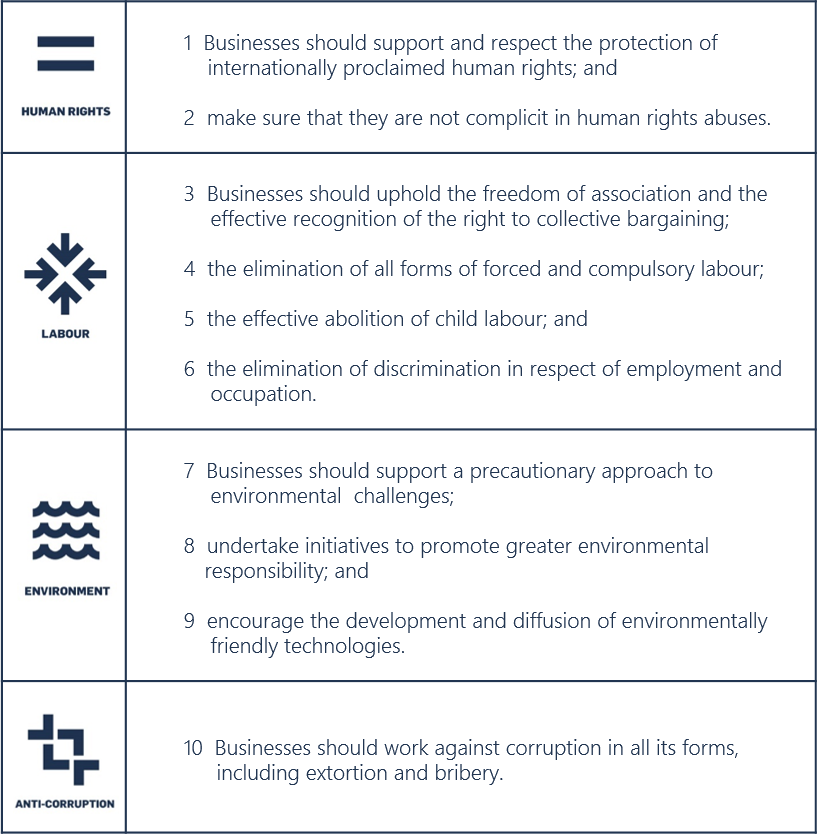
On March 26, 2023, we have supported and participated in the United Nations Global Compact, a corporate sustainability initiative with universal principles on human rights, labor, environment and anti-corruption.
Through Global Compact Network Japan, a local network in Japan of the UN Global Compact, we will deepen our knowledge in related fields and use it for sustainability activities in our company.
Employees are encouraged to participate in workshops and attend various seminars organized by the Global Compact Network Japan (GCNJ), as part of the Company’s sustainability activities.
- Participation in subcommittee